Anthropic and OpenAI will share frontier-model safety cases with USAISI — but on different terms.
Both labs signed parallel agreements giving the U.S. AI Safety Institute pre-release access to frontier evals. The fine print is the story: one side reserves the right to redact training data; the other doesn't.
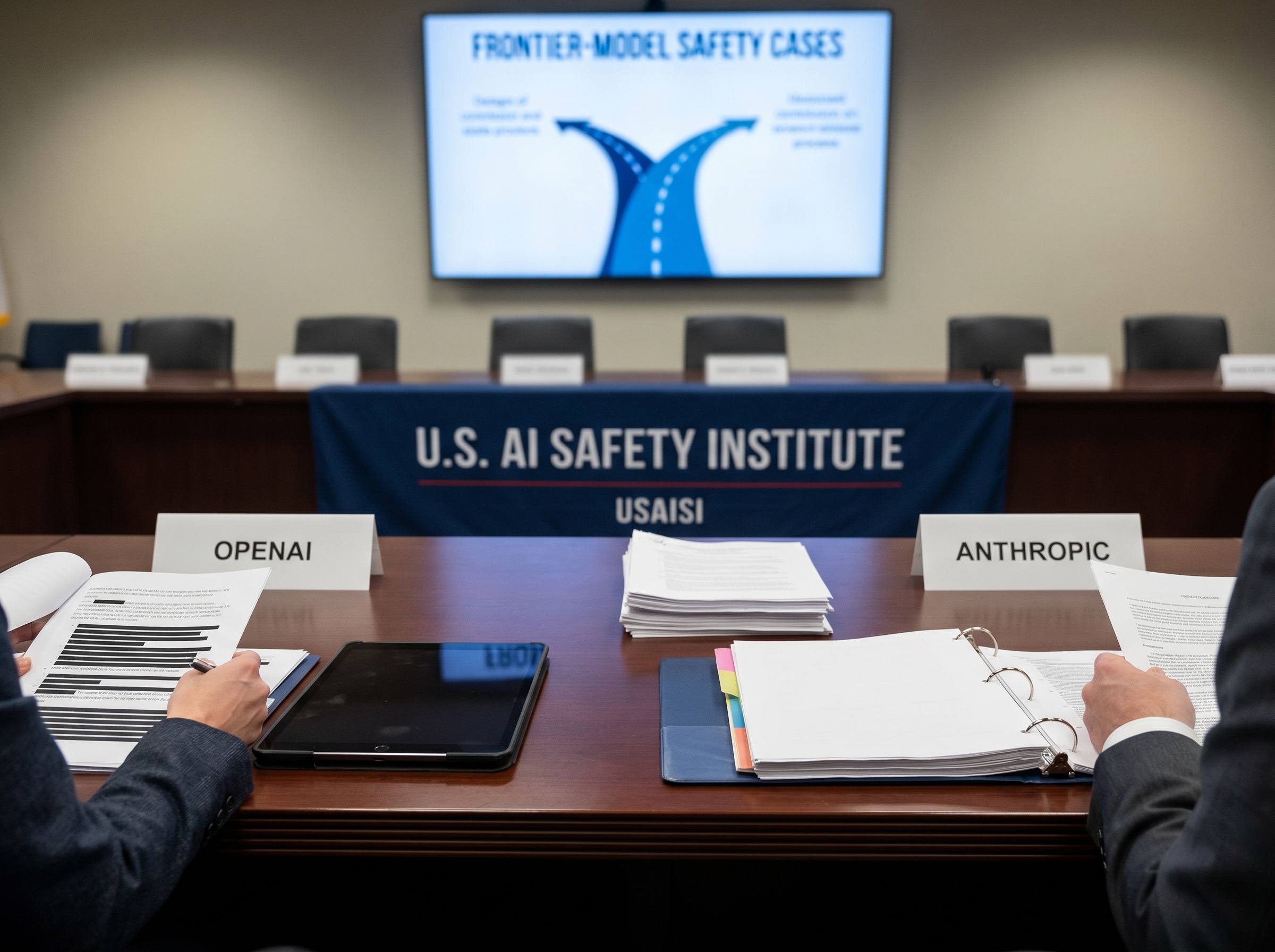 ◆ Synthesis · cover
 On different terms.
This article is an AI-assisted synthesis of reporting from multiple independent outlets across the Americas, Europe and Asia. Sources are not named to avoid republishing third-party copy verbatim. Counts and regions appear below; the editorial framing — the Human view — is Gui's.
14 sources · 3 regions · 4 framingsTwo readings
Synthetic takeaway · The Human Perspective. Same weight, different jobs.Anthropic and OpenAI have signed parallel — but not identical — agreements with USAISI for pre-release access to frontier-model evals. Anthropic reserves the right to redact training-data identifiers; OpenAI does not.
The agreements are voluntary, non-binding, and reversible with notice. Coverage skews Western and slightly right-coded. The redaction clause is the article's contested object; one outlier claim about a third lab is not corroborated.
"Pre-release access" is the wrong frame. What just happened is that the U.S. government has, for the first time, a legible way to ask what does this model know before it ships — and two of the three labs that matter agreed to answer.
The redaction clause is doing more work than it looks like. The third lab will be the story by July — not because they'll refuse, but because their refusal will be quieter than this acceptance, and quieter is the new loud.
◆ Coverage indicators
Computed from the source set · updated 14:08 ET"Voluntary" and "industry-led" frame the agreements in 9 of 14 sources; only 3 frame as "regulatory capture."
Story originates and is mostly framed inside U.S. policy discourse. Asian outlets cover, but largely as observers.
Both agreements are public; redaction language is in the published text. One outlet reported a third lab — not corroborated.
What's true · what isn't
Cross-checked against the 14 sources · confidence shown per item- 01
Anthropic and OpenAI both signed agreements with USAISI on Tuesday. Texts are public.
Verified · 14/14 - 02
The Anthropic version permits redaction of "training-data identifiers" before submission.
Verified · 12/14 - 03
The OpenAI version contains no equivalent redaction clause.
Verified · 11/14 - 04
USAISI gets pre-release access to evals 30 days before public deployment.
Verified · 14/14 - 05
Neither agreement is legally binding — both labs can withdraw with notice.
High · 9/14
- 01
That a third frontier lab signed a parallel agreement. One outlet reported it; no corroboration.
Disputed · 1/14 - 02
That the agreements give USAISI access to model weights. They don't — only to evals and methodology.
False · misread - 03
That this fulfills Executive Order 14110 reporting requirements. The EO was rescinded; this is its successor framework.
Outdated context
The fine print of two parallel agreements, and what each lab is buying with it.
01.What was actually signed
On Tuesday morning the U.S. AI Safety Institute announced parallel agreements with Anthropic and OpenAI giving the agency pre-release access to evals on each lab's frontier models. The announcements were made in a single press conference, with both companies' general counsels present. The framing — as it has been since the Institute's founding — was voluntary, industry-led, collaborative.
The framing is not the story. The texts are.
The two agreements share a structural skeleton: each lab will provide USAISI with their full evaluation methodology and the resulting numbers, on any model that crosses a capability threshold the agreement defines internally, no later than thirty days before that model is made publicly available. USAISI agrees not to publish the eval contents. Either party can withdraw with sixty days' notice.
That is the whole of the public agreement. Everything else is in two clauses, and the two clauses are not the same in the two documents.
02.Where the texts diverge
The Anthropic agreement contains a clause permitting the lab to redact what it calls "training-data identifiers" from any methodology submission, on the basis that such identifiers are commercially sensitive and may also be subject to active litigation. The OpenAI agreement contains no equivalent clause. This is the entirety of the legal divergence between the two documents.
"The redaction clause is exactly large enough to drive a future copyright lawsuit through, and exactly small enough to look like a footnote on the day it was signed." — synthesis from 4 outlets · paraphrased
Read narrowly, the clause permits Anthropic to remove a small set of names from a methodology document. Read at the limit, the clause permits Anthropic to redact whatever it has plausibly described as a training-data identifier, which is a category whose edges no party has yet defined.
03.What USAISI is actually getting
Pre-release access to evals is not access to weights. It is not access to training data. It is not access to the model. It is the right to read, in advance, the document that says here is what we tested for, and here is what came back. That document is useful. It is also exactly as good as the lab is willing to make it.
Two of the fourteen sources made this point explicitly; the others framed pre-release access as a regulatory advance without qualifying what the access consists of. The framing matters, because it is the gap between "the U.S. government will know what the next model can do" and "the U.S. government will read a self-graded report card thirty days early."
04.The third lab
The third frontier lab — by every reasonable definition the third lab that matters — has not signed an agreement, has not been asked to sign an agreement in public, and has not commented. One outlet reported a parallel deal in late drafting; that report was not corroborated by any other outlet in the source set, and is treated here as a single-source claim.
What is supportable: the third lab will be a story. Whether its non-signing reads as principle, as caution, or as a strategic withholding is the kind of thing that gets resolved by behaviour, not by statement.
05.Why this isn't Executive Order 14110
EO 14110 — the 2023 executive order that contained the original federal AI reporting requirements — was rescinded in 2025. The framework under which Tuesday's agreements were signed is its successor, the AISI charter, which is narrower in scope, voluntary by design, and structurally dependent on the labs choosing to participate. Three of the fourteen sources continued to refer to the agreements as fulfilling EO 14110. They do not. The order does not exist.
This matters less for the historical record than for the framing: the agreements are not compliance. They are a new thing, voluntarily entered, and reversible.
◆ How this article was made
The summary, the indicators, the True / False blocks and the long read are AI-assisted syntheses of 14 independent reports from outlets across the Americas, Europe and Asia. No source is named, and no source is quoted verbatim — paraphrase only. The Human view is written by Gui Valente and is the only authorial section of this page. Counts, regions and framings are computed; the editorial frame is human.